Buy farmaciadelcarmine.pisa.it ?
We are moving the project
farmaciadelcarmine.pisa.it .
Are you interested in purchasing the domain
farmaciadelcarmine.pisa.it ?
domain@kv-gmbh.de · 0541-91531010
Buy farmaciadelcarmine.pisa.it ?
How do you draw trehalose in a 2-11 glycosidic bond?
To draw trehalose in a 2-11 glycosidic bond, you would first draw two glucose molecules connected by an alpha-1,1 glycosidic bond. Then, you would add another glucose molecule to the first glucose molecule in the 2 position, forming a 1,2 glycosidic bond. Finally, you would add the last glucose molecule to the second glucose molecule in the 1 position, forming a 2,1 glycosidic bond. This structure represents trehalose in a 2-11 glycosidic bond. **
What is a hardship health and care assessment?
A hardship health and care assessment is a process where an individual's health and care needs are evaluated to determine the level of support required. This assessment is typically conducted by social services or healthcare professionals to identify any challenges or difficulties the individual may be facing in managing their health and care needs. The assessment aims to ensure that the individual receives the appropriate level of support and services to help them maintain their well-being and quality of life despite any hardships they may be experiencing. **

Similar search terms for Bond-11-Assessment-Practice
Top-Angebote
Products related to Bond-11-Assessment-Practice:
-
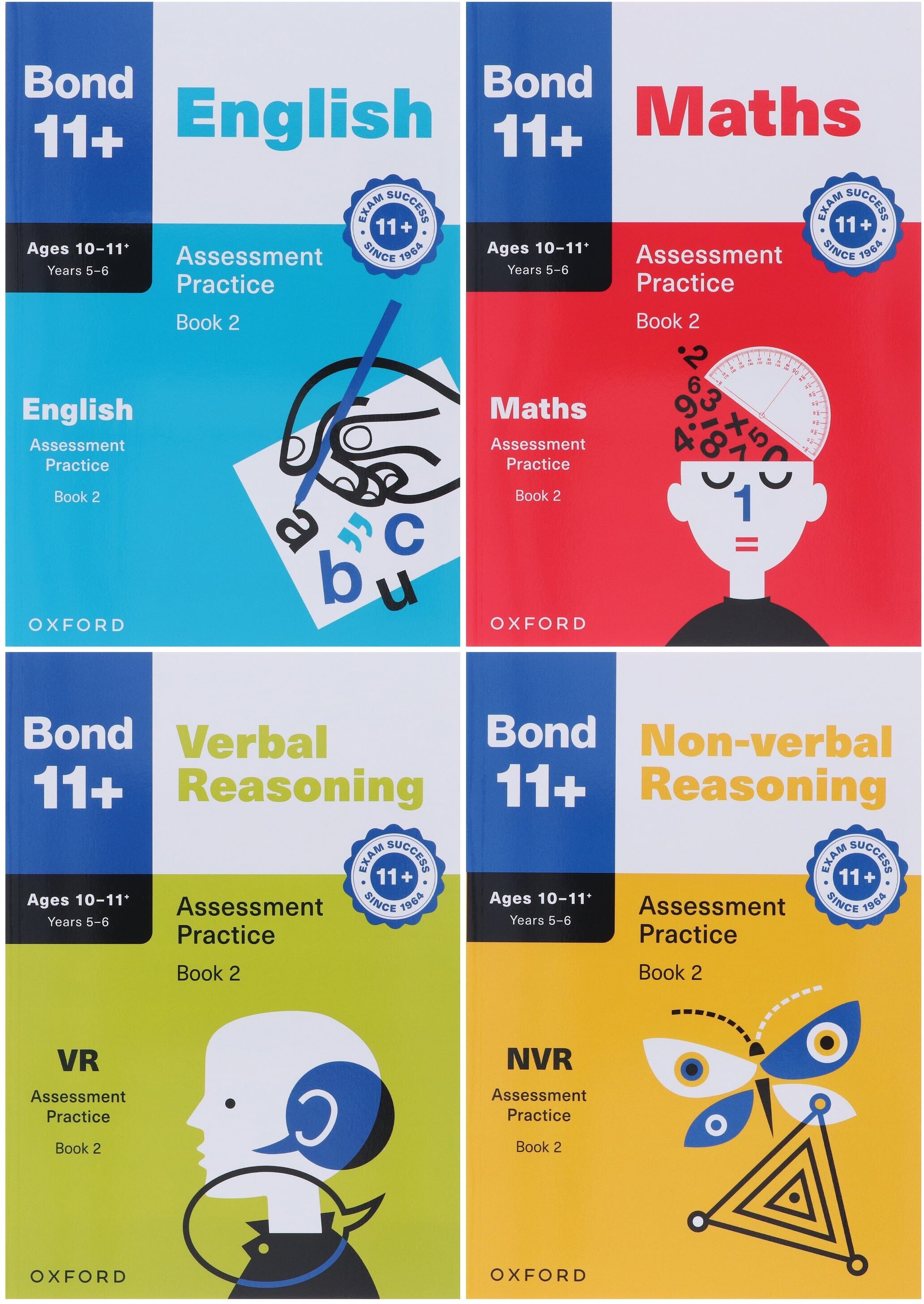
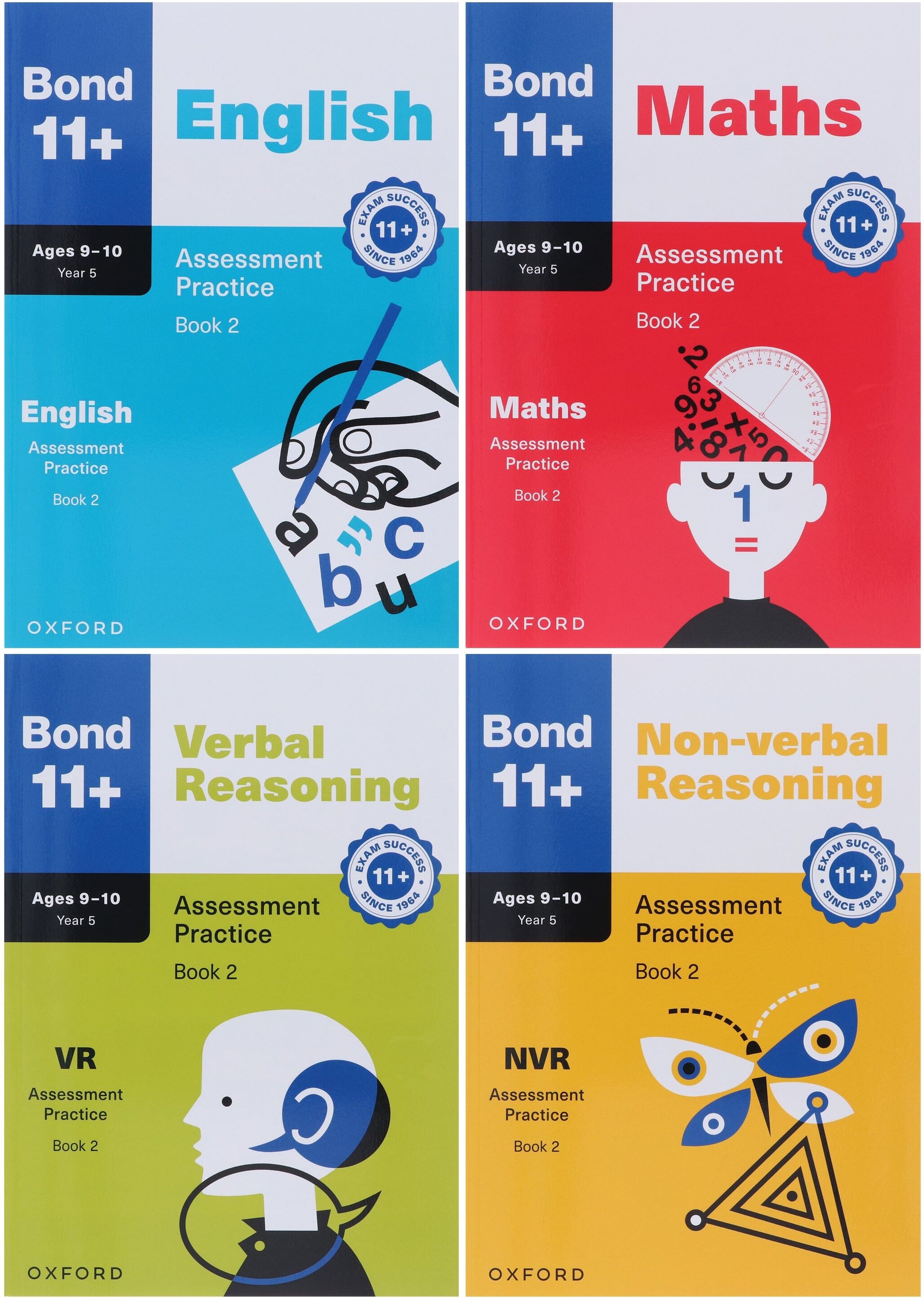
Bond 11+ Assessment Practice Papers for Year 5-6 (Book 2) 4 Books Set - Ages 10-11+ - Paperback OUP OxfordBoost 11+ skills with even more practice in Assessment Practice Book 2! Building on the comprehensive guidance of Age 10-11+, the Assessment Practice Book 2s are packed with hundreds of additional practice questions that consolidate skills and build confidence for the 11+ exams. Developed and written by experienced tutors , these books are perfect for preparing for the GL Assessment and other admissions tests including the Kent Test. Each subject-specific book contains at least: • 8 Topic Papers for targeted practice of all the key 11+ skills your child needs • 4 Mixed Papers which combine questions on different topics to consolidate skills • 2 full Test Papers , offering realistic exam-style practice Key features include: • Suitable for ages 10-11+ and children in Years 5-6 • Covers all of the key 11+ topics across English, maths, verbal reasoning, and non-verbal reasoning • Full answer explanations in a removable booklet support greater understanding • Supports skill development and progression , building all-important exam confidence • Curveball questions help children adapt to unusual question types • Guidance for parents on how to get the most out of the books, and general advice on preparing for the exam Titles in this Set: 1. English Assessment Practice 2. Maths Assessment Practice 3. Verbal Reasoning Assessment Practice 4. Non-Verbal Reasoning Assessment Practice17,99 £*Shipping: 2,99 £Secure redirect to the provider
-
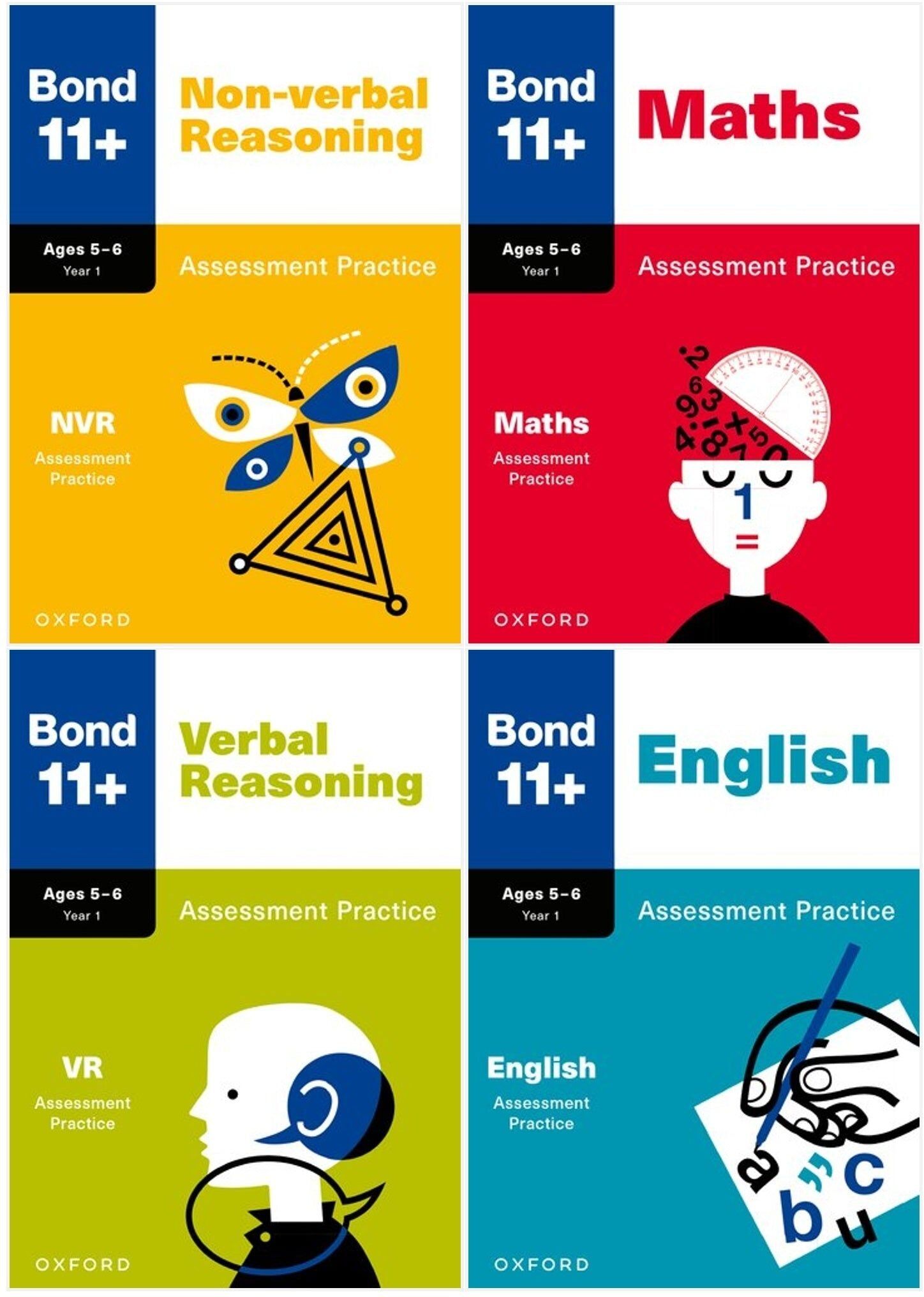
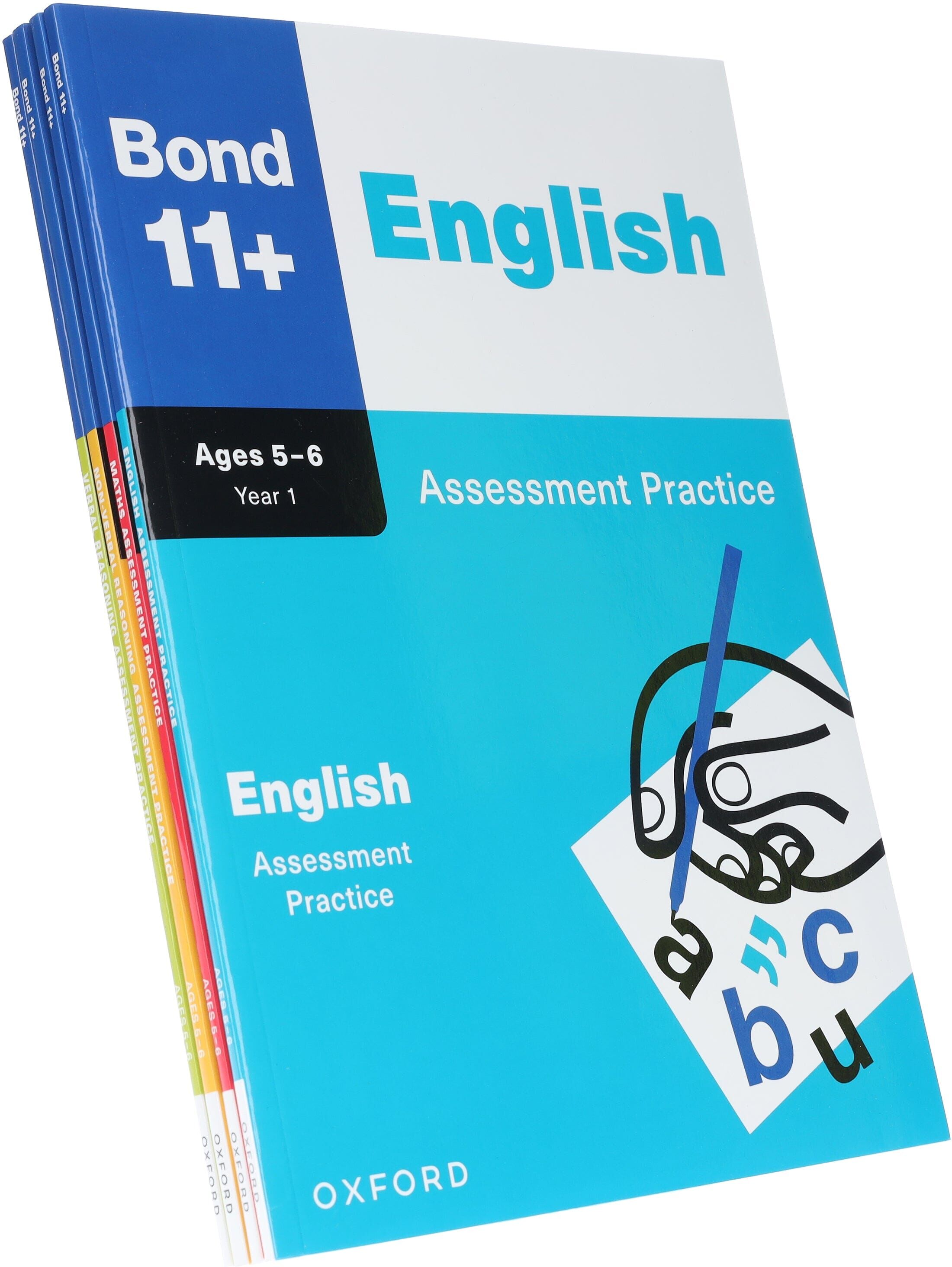
Bond 11+ Assessment Practice Year 1 (Ages 5-6) By Oxford: 4 Books Collection Set - Paperback Oxford University PressTitles in this set: 1. Bond 11+ English Assessment Practice 2. Bond 11+ Maths Assessment Practice 3. Bond 11+ Verbal Reasoning Assessment Practice 4. Bond 11+ Non-verbal Reasoning Assessment Practice Description: Bond 11+ English, Maths, Verbal Reasoning & Non-Verbal Reasoning Assessment Practice for age 5-6 years offers accessible practice questions for children starting their journey towards the 11+ test. This fully revised edition includes essential guidance and full answer explanations and will develop the skills that are vital for success. Developed and written by experienced tutors, Bond 11+ Assessment Practice Books offer exam-style practice questions, perfect for preparing for the GL 11+ exam and other selective school tests, with full answer explanations in a removable booklet. Key features include: Bursting with guidance and tutor tips , offering the best possible preparation for the 11+ English exam and KS2 SATs Can also be used for the 7+ and 8+ exams Aids progression by starting with topic-focussed papers, before moving to mixed- topic tests, building all-important exam confidence Puzzle questions help children adapt to unusual question types Detailed answer explanations empower children with greater understanding Perfect for preparing for the GL 11+ test and other school entrance exams For ages 5-6 and children in Year 1 Bond 11+ English Assessment Practice Covers all of the core 11+ English exam topics including comprehension, spelling, sentences, punctuation, and grammar. Bond 11+ Maths Assessment Practice Covers a wide variety of maths topics including place value, addition and subtraction, multiplication and division, fractions, shapes, measurement, and diagrams. Bond 11+ Verbal Reasoning Assessment Practice Covers a wide variety of verbal reasoning topics including word meanings, sorting and choosing words, codes, numbers, and sequences. Bond 11+ Non-verbal Reasoning Assessment Practice Covers a wide variety of non-verbal reasoning topics including odd one out, similarities, analogies, hidden shapes, and matching shapes.14,40 £*Shipping: 2,99 £Secure redirect to the provider
-
Can you give me a mathematical word problem for practice in an online job assessment test?
Sure! Here's a mathematical word problem for practice: A company produces 500 units of a product per day. If the production cost is $2 per unit and the selling price is $5 per unit, how much profit does the company make in a week (assuming 5 working days)? **
-
What are the differences between a single bond, a double bond, and a triple bond?
A single bond involves the sharing of one pair of electrons between two atoms, while a double bond involves the sharing of two pairs of electrons. A triple bond involves the sharing of three pairs of electrons between two atoms. As the number of shared electron pairs increases, the bond becomes stronger and shorter. Additionally, double and triple bonds are typically found in molecules with carbon atoms, while single bonds are more common in organic compounds. **
-
What are the differences between an ionic bond, a metallic bond, and a covalent bond?
Ionic bonds involve the transfer of electrons from one atom to another, resulting in the attraction between oppositely charged ions. Metallic bonds involve the sharing of electrons among a sea of delocalized electrons, creating a strong bond between metal atoms. Covalent bonds involve the sharing of electrons between atoms to achieve a stable electron configuration. Each type of bond has different properties and strengths based on the way electrons are shared or transferred between atoms. **
-
What are the differences between a glycosidic bond, a peptide bond, and an ester bond?
Glycosidic bonds are formed between a sugar molecule and another molecule, such as another sugar or a non-carbohydrate compound. Peptide bonds are specific types of covalent bonds that link amino acids together in proteins. Ester bonds are formed between a carboxylic acid and an alcohol, resulting in the formation of an ester. Each of these bonds plays a crucial role in the structure and function of biological molecules, with glycosidic bonds being important in carbohydrates, peptide bonds in proteins, and ester bonds in lipids. **
Is ethanol an atomic bond or an ionic bond?
Ethanol is a molecular compound, meaning it is made up of covalent bonds. Covalent bonds are formed when atoms share electrons to achieve a stable electron configuration. In the case of ethanol, it is composed of carbon, hydrogen, and oxygen atoms bonded together through covalent bonds. Ionic bonds, on the other hand, are formed between ions with opposite charges. **
What is the bond angle in a peptide bond?
The bond angle in a peptide bond is approximately 120 degrees. This angle is due to the partial double bond character of the peptide bond, which is formed between the carbonyl carbon of one amino acid and the nitrogen of another amino acid. The resonance structure of the peptide bond results in a planar arrangement of the atoms, leading to the bond angle of approximately 120 degrees. **
Top-Angebote
Products related to Bond-11-Assessment-Practice:
-
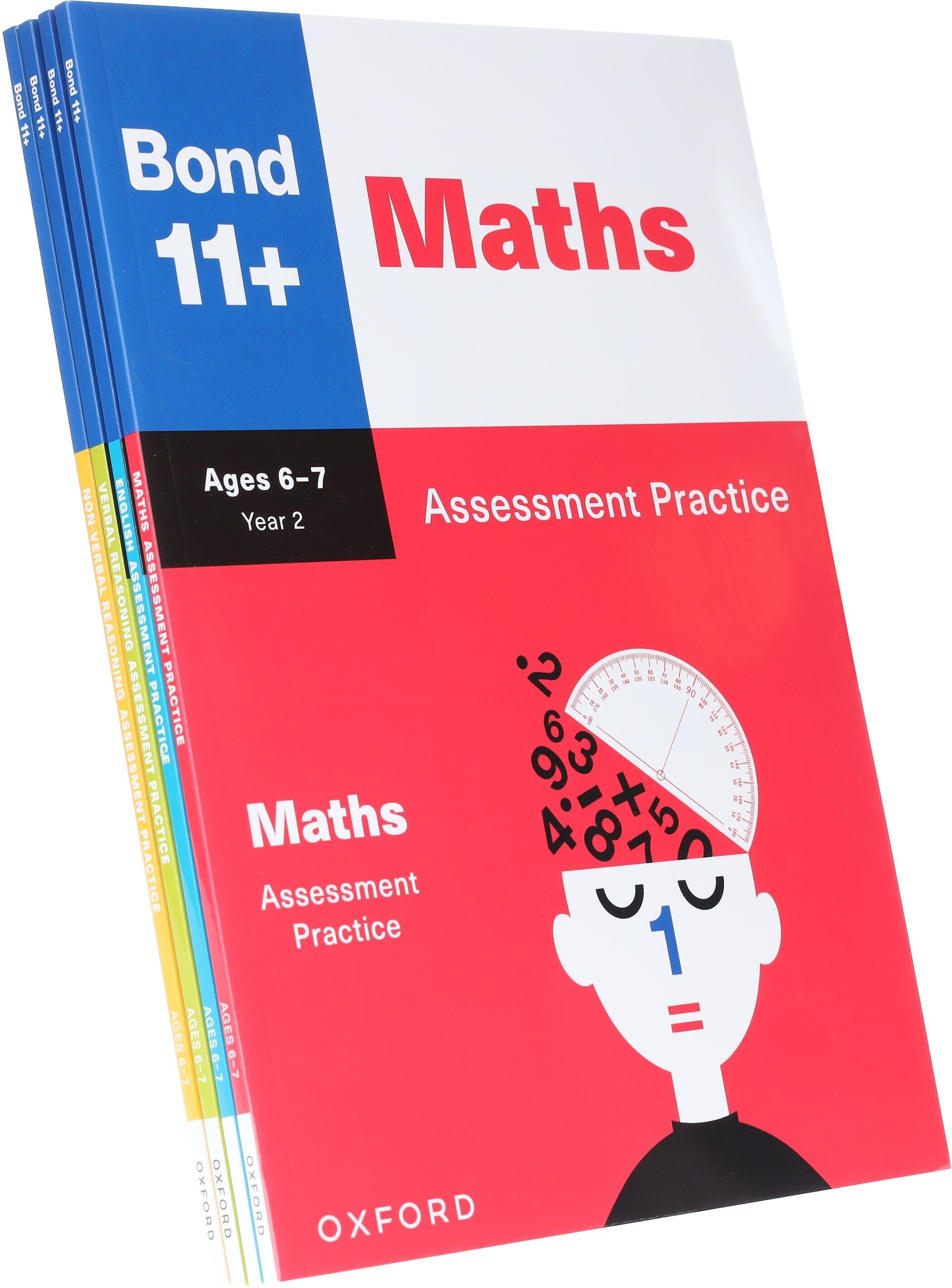
OXFORD UNIVERSITY PRESS Bond 11+ Maths English Verbal Non-Verbal Reasoning Assessment Practice 6-7 years 4 Books Set (Bond Assessment Papers)Bond 11+ Maths English Verbal Non-Verbal Reasoning Assessment Practice 6-7 years 4 Books Set (Bond Assessment Papers) Year 2 Developed and written by experienced tutors, Bond 11+ Assessment Practice Books offer exam-style practice questions, perfect for preparing for the GL 11+ exam and other selective school tests, with full answer explanations in a removable booklet. Bond 11+ English Assessment Practice Age 6-7: Covers all of the core 11+ English exam topics including comprehension, spelling, sentences, punctuation, and grammar Bond 11+ Maths Assessment Practice Age 6-7: Covers a wide variety of maths topics including place value, multiplication and division, fractions, shapes, measurement, and diagrams Bond 11+ Non-verbal Reasoning Assessment Practice Age 6-7: Covers a wide variety of non-verbal reasoning topics including shapes, angles and rotation, similarities, sequences, reflections, and grids Bond 11+ Verbal Reasoning Assessment Practice Age 6-7: Covers a wide variety of verbal reasoning topics including word meanings, word connections, missing letters, patterns and sequences, anagrams, and codes15,99 £*Shipping: 2,99 £Secure redirect to the provider
-
OXFORD UNIVERSITY PRESS Bond 11+ Maths English Verbal Non-Verbal Reasoning Assessment Practice 5-6 years 4 Books Set (Bond Assessment Papers)Bond 11+ English; Maths; Non-verbal Reasoning; Verbal Reasoning Assessment Practice 4 Books Set (Age 5-6) The pack includes the following 4 books (Bond 11 Plus books) Bond 11+ Maths Assessment Practice Ages 5-6 Bond Maths Assessment Practice for 5-6 years are topic-based practice questions that set the foundation for success in SATs; common entrance or 11+ exams. They have been written to cover the core National Curriculum skills and cover the question types used in 11+ exams; building the skills and confidence for exam success. Bond 11+ English Assessment Practice Ages 5-6 Bond English Assessment Practice for 5-6 years are topic-based practice questions that set the foundation for success in SATs; common entrance or 11+ exams. They have been written to cover the core National Curriculum skills and cover the question types used in 11+ exams; building the skills and confidence for exam success Bond 11+ Verbal Reasoning Assessment Practice Ages 5-6 Bond Verbal Reasoning Assessment Practice for 5-6 years introduces children to verbal reasoning problem-solving skills; encouraging thinking skills and providing early preparation for Common Entrance and 11+ exams. Bond 11+ Non-Verbal Reasoning Assessment Practice Ages 5-6 Bond Non-verbal Reasoning Assessment Practice for 5-6 years introduces children to non-verbal reasoning problem-solving skills; encouraging thinking skills and providing early preparation for Common Entrance and 11+ exams.14,40 £*Shipping: 2,99 £Secure redirect to the provider
-
How do you draw trehalose in a 2-11 glycosidic bond?
To draw trehalose in a 2-11 glycosidic bond, you would first draw two glucose molecules connected by an alpha-1,1 glycosidic bond. Then, you would add another glucose molecule to the first glucose molecule in the 2 position, forming a 1,2 glycosidic bond. Finally, you would add the last glucose molecule to the second glucose molecule in the 1 position, forming a 2,1 glycosidic bond. This structure represents trehalose in a 2-11 glycosidic bond. **
-
What is a hardship health and care assessment?
A hardship health and care assessment is a process where an individual's health and care needs are evaluated to determine the level of support required. This assessment is typically conducted by social services or healthcare professionals to identify any challenges or difficulties the individual may be facing in managing their health and care needs. The assessment aims to ensure that the individual receives the appropriate level of support and services to help them maintain their well-being and quality of life despite any hardships they may be experiencing. **
-
Can you give me a mathematical word problem for practice in an online job assessment test?
Sure! Here's a mathematical word problem for practice: A company produces 500 units of a product per day. If the production cost is $2 per unit and the selling price is $5 per unit, how much profit does the company make in a week (assuming 5 working days)? **
-
What are the differences between a single bond, a double bond, and a triple bond?
A single bond involves the sharing of one pair of electrons between two atoms, while a double bond involves the sharing of two pairs of electrons. A triple bond involves the sharing of three pairs of electrons between two atoms. As the number of shared electron pairs increases, the bond becomes stronger and shorter. Additionally, double and triple bonds are typically found in molecules with carbon atoms, while single bonds are more common in organic compounds. **
Similar search terms for Bond-11-Assessment-Practice
-
Bond 11+ Assessment Practice Papers for Year 5-6 (Book 2) 4 Books Set - Ages 10-11+ - Paperback OUP OxfordBoost 11+ skills with even more practice in Assessment Practice Book 2! Building on the comprehensive guidance of Age 10-11+, the Assessment Practice Book 2s are packed with hundreds of additional practice questions that consolidate skills and build confidence for the 11+ exams. Developed and written by experienced tutors , these books are perfect for preparing for the GL Assessment and other admissions tests including the Kent Test. Each subject-specific book contains at least: • 8 Topic Papers for targeted practice of all the key 11+ skills your child needs • 4 Mixed Papers which combine questions on different topics to consolidate skills • 2 full Test Papers , offering realistic exam-style practice Key features include: • Suitable for ages 10-11+ and children in Years 5-6 • Covers all of the key 11+ topics across English, maths, verbal reasoning, and non-verbal reasoning • Full answer explanations in a removable booklet support greater understanding • Supports skill development and progression , building all-important exam confidence • Curveball questions help children adapt to unusual question types • Guidance for parents on how to get the most out of the books, and general advice on preparing for the exam Titles in this Set: 1. English Assessment Practice 2. Maths Assessment Practice 3. Verbal Reasoning Assessment Practice 4. Non-Verbal Reasoning Assessment Practice17,99 £*Shipping: 2,99 £Secure redirect to the provider
-
Bond 11+ Assessment Practice Year 1 (Ages 5-6) By Oxford: 4 Books Collection Set - Paperback Oxford University PressTitles in this set: 1. Bond 11+ English Assessment Practice 2. Bond 11+ Maths Assessment Practice 3. Bond 11+ Verbal Reasoning Assessment Practice 4. Bond 11+ Non-verbal Reasoning Assessment Practice Description: Bond 11+ English, Maths, Verbal Reasoning & Non-Verbal Reasoning Assessment Practice for age 5-6 years offers accessible practice questions for children starting their journey towards the 11+ test. This fully revised edition includes essential guidance and full answer explanations and will develop the skills that are vital for success. Developed and written by experienced tutors, Bond 11+ Assessment Practice Books offer exam-style practice questions, perfect for preparing for the GL 11+ exam and other selective school tests, with full answer explanations in a removable booklet. Key features include: Bursting with guidance and tutor tips , offering the best possible preparation for the 11+ English exam and KS2 SATs Can also be used for the 7+ and 8+ exams Aids progression by starting with topic-focussed papers, before moving to mixed- topic tests, building all-important exam confidence Puzzle questions help children adapt to unusual question types Detailed answer explanations empower children with greater understanding Perfect for preparing for the GL 11+ test and other school entrance exams For ages 5-6 and children in Year 1 Bond 11+ English Assessment Practice Covers all of the core 11+ English exam topics including comprehension, spelling, sentences, punctuation, and grammar. Bond 11+ Maths Assessment Practice Covers a wide variety of maths topics including place value, addition and subtraction, multiplication and division, fractions, shapes, measurement, and diagrams. Bond 11+ Verbal Reasoning Assessment Practice Covers a wide variety of verbal reasoning topics including word meanings, sorting and choosing words, codes, numbers, and sequences. Bond 11+ Non-verbal Reasoning Assessment Practice Covers a wide variety of non-verbal reasoning topics including odd one out, similarities, analogies, hidden shapes, and matching shapes.14,40 £*Shipping: 2,99 £Secure redirect to the provider
-
Bond 11+ Assessment Practice (Book 2) for Ages 9-10 (Year 5) 4 Books Collection Set - Paperback OUP OxfordThe Bond 11+ Assessment Practice Book 2 Bundle for age 9-10 years includes four subject-specific books offering exam-style practice questions for children preparing for the 11+ test. With essential guidance and full answer explanations these books develop the skills that are vital for success. Titles in this Set: 1. English Assessment Practice 2. Maths Assessment Practice 3. Verbal Reasoning Assessment Practice 4. Non-Verbal Reasoning Assessment Practice Boost 11+ skills with even more practice in Assessment Practice Book 2! Building on the comprehensive guidance of Age 9-10, the Assessment Practice Book 2s are packed with hundreds of additional practice questions that consolidate skills and build confidence for the 11+ exams. Developed and written by experienced tutors , these books are perfect for preparing for the GL Assessment and other admissions tests including the Kent Test. Each subject-specific book contains at least: • 8 Topic Papers for targeted practice of all the key 11+ skills your child needs • 4 Mixed Papers which combine questions on different topics to consolidate skills • 2 full Test Papers , offering realistic exam-style practice Key features include: • Suitable for ages 9-10 and children in Year 5 • Covers all of the key 11+ topics across English, maths, verbal reasoning, and non-verbal reasoning • Full answer explanations in a removable booklet support greater understanding • Supports skill development and progression , building all-important exam confidence • Curveball questions help children adapt to unusual question types • Guidance for parents on how to get the most out of the books, and general advice on preparing for the exam17,99 £*Shipping: 2,99 £Secure redirect to the provider
-
Bond 11+ Maths and English Verbal & Non-Verbal Reasoning Assessment Practice 4 Books Collection Set – Ages 6-7 Years- Paperback Oxford University PressTitles in this Set: 1. Bond 11+ English Assessment Practice 2. Bond 11+ Maths Assessment Practice 3. Bond 11+ Non-verbal Reasoning Assessment Practice 4. Bond 11+ Verbal Reasoning Assessment Practice Description: Bond 11+ English Assessment Practice Bond 11+ English Assessment Practice for age 6-7 years offers accessible practice questions for children starting their journey towards the 11+ test. This fully revised edition includes essential guidance and full answer explanations and will develop the skills that are vital for success. Bond 11+ Maths Assessment Practice Bond 11+ Maths Assessment Practice for age 6-7 years offers accessible practice questions for children starting their journey towards the 11+ test. This fully revised edition includes essential guidance and full answer explanations and will develop the skills that are vital for success. Bond 11+ Non-verbal Reasoning Assessment Practice Bond 11+ Non-verbal Reasoning Assessment Practice for age 6-7 years offers accessible practice questions for children starting their journey towards the 11+ test. This fully revised edition includes essential guidance and full answer explanations and will develop the skills that are vital for success. Bond 11+ Verbal Reasoning Assessment Practice Bond 11+ Verbal Reasoning Assessment Practice for age 6-7 years offers accessible practice questions for children starting their journey towards the 11+ test. This fully revised edition includes essential guidance and full answer explanations and will develop the skills that are vital for success.16,99 £*Shipping: 2,99 £Secure redirect to the provider
-
What are the differences between an ionic bond, a metallic bond, and a covalent bond?
Ionic bonds involve the transfer of electrons from one atom to another, resulting in the attraction between oppositely charged ions. Metallic bonds involve the sharing of electrons among a sea of delocalized electrons, creating a strong bond between metal atoms. Covalent bonds involve the sharing of electrons between atoms to achieve a stable electron configuration. Each type of bond has different properties and strengths based on the way electrons are shared or transferred between atoms. **
-
What are the differences between a glycosidic bond, a peptide bond, and an ester bond?
Glycosidic bonds are formed between a sugar molecule and another molecule, such as another sugar or a non-carbohydrate compound. Peptide bonds are specific types of covalent bonds that link amino acids together in proteins. Ester bonds are formed between a carboxylic acid and an alcohol, resulting in the formation of an ester. Each of these bonds plays a crucial role in the structure and function of biological molecules, with glycosidic bonds being important in carbohydrates, peptide bonds in proteins, and ester bonds in lipids. **
-
Is ethanol an atomic bond or an ionic bond?
Ethanol is a molecular compound, meaning it is made up of covalent bonds. Covalent bonds are formed when atoms share electrons to achieve a stable electron configuration. In the case of ethanol, it is composed of carbon, hydrogen, and oxygen atoms bonded together through covalent bonds. Ionic bonds, on the other hand, are formed between ions with opposite charges. **
-
What is the bond angle in a peptide bond?
The bond angle in a peptide bond is approximately 120 degrees. This angle is due to the partial double bond character of the peptide bond, which is formed between the carbonyl carbon of one amino acid and the nitrogen of another amino acid. The resonance structure of the peptide bond results in a planar arrangement of the atoms, leading to the bond angle of approximately 120 degrees. **
* All prices are inclusive of VAT and, if applicable, plus shipping costs. The offer information is based on the details provided by the respective shop and is updated through automated processes. Real-time updates do not occur, so deviations can occur in individual cases. ** Note: Parts of this content were created by AI.